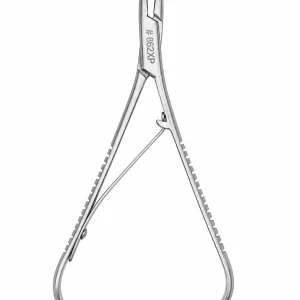
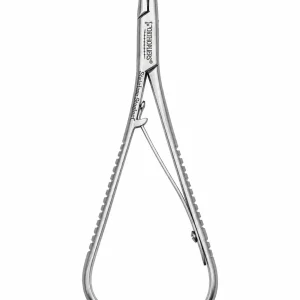
 The Keat Buccal Tweezer is a precision orthodontic instrument designed for securely holding, positioning, and transferring brackets, buccal tubes, attachments, and other small orthodontic components during bonding and clinical procedures. Its finely aligned tips provide exceptional grip and accuracy, allowing clinicians to place delicate accessories with confidence while minimizing the risk of slippage.
Manufactured from premium surgical stainless steel, the Keat Buccal Tweezer offers outstanding durability, corrosion resistance, and long-lasting clinical performance. Its lightweight, ergonomic design enhances tactile sensitivity and operator comfort, making it an indispensable instrument for orthodontists performing direct bonding and fixed appliance treatment.
Key Features
-
- Precision-aligned tips provide a secure grip on orthodontic components.
- Designed for handling brackets, buccal tubes, buttons, and auxiliary attachments.
- Facilitates accurate placement during direct bonding procedures.
- Fine tips allow precise manipulation in confined intraoral spaces.
- Lightweight ergonomic design improves comfort and tactile control.
- Manufactured from premium surgical stainless steel.
- Excellent resistance to corrosion and repeated sterilization.
- Smooth spring action ensures consistent handling performance.
- Fully autoclavable for routine infection control.
- Suitable for both chairside and laboratory applications.
Technical Specifications
| Specification | Details |
| Product Name | Keat Buccal Tweezer |
| SKU | N21150454 |
| Instrument Type | Orthodontic Buccal Tweezer |
| Function | Holding and Positioning Orthodontic Components |
| Tip Design | Precision Fine Tips |
| Material | Premium Surgical Stainless Steel |
| Finish | Satin Finish |
| Reusable | Yes |
| Sterilization | Autoclavable |
| Corrosion Resistant | Yes |
| Professional Use | Orthodontics |
Professional Applications
The Keat Buccal Tweezer is recommended for:
-
- Placement of orthodontic brackets.
- Handling buccal tubes and molar attachments.
- Positioning orthodontic buttons.
- Manipulating small orthodontic accessories.
- Direct bonding procedures.
- Chairside orthodontic appliance placement.
- Laboratory handling of orthodontic components.
- General orthodontic clinical procedures.